
INDUSTRY:
SAAS PLATFORM
CLIENT:
BRYJ.AI
EXPERIENCE:
PRODUCT DESIGN LEAD
How Design an App Builder That Drove Partner Acquisition
and Unified Platform Control
Lead Product Designer
App Builder
Low-Code Platform
B2B/ Agency Mode
Customer acquisition
UX Strategy
Design Specs
About.
Designing a Low-Code App Builder Platform for our partner clients and/or external clients in an agency mode.
Problem Statement -> How do we make app creation intuitive and visual for non-developers, without oversimplifying and losing the technical depth that power users need — all while keeping teams connected to their data and analytics in one place?
Bryj needed to build a low-code application builder to:
Attract new customers: agencies and partners needed a way to create custom branded apps without building from scratch, while remaining able to connect those apps directly to Bryj's analytics platform and manage their entire mobile engagement strategy from a single unified dashboard.
Activate existing clients: existing Bryj users could extend their mobile engagement capabilities by creating their own apps, with seamless integration to their existing audience data and campaign analytics, eliminating data silos and providing a complete 360° view of performance from one centralized control center.
Overcome the technical barrier: the challenge was designing something both accessible for non-technical users (marketing, product teams) while retaining advanced options for developers and technical partners.
My main responsibilities:
Gathering requirements from the Growth/CSM team.
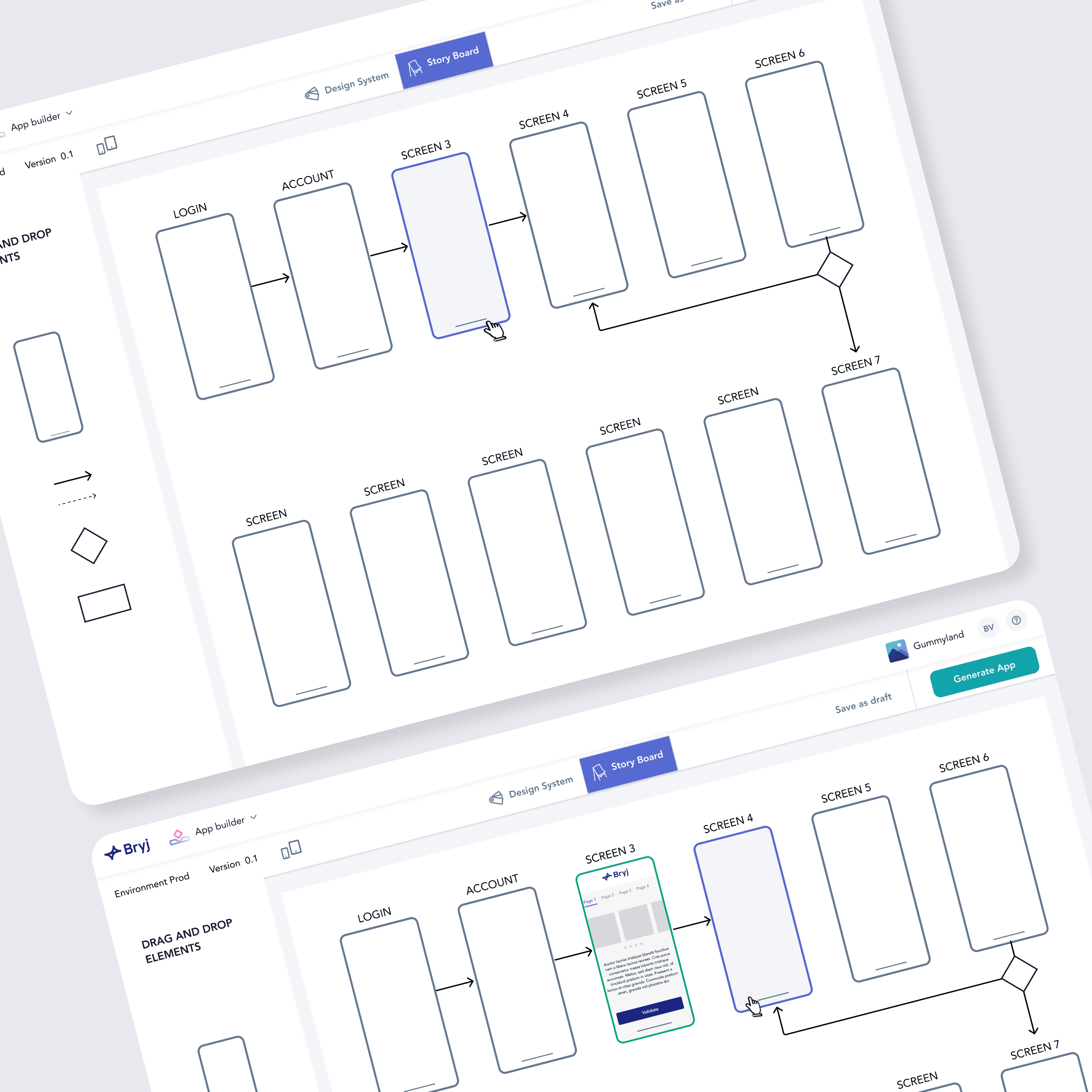
Creating high-fidelity wireframes and prototypes to support design iteration with the product team.
Objective: Improve product understanding for developers and facilitate the definition of technical specifications.
Developing prototypes that help the product team convince leadership and investors.
Defining design specifications to ensure consistency and usability.
Enhancing the design system and creating components aligned with the Growth platform.
Overseeing QA throughout the development process.
How Design an App Builder
That Drove Partner Acquisition
and Unified Platform Control
Lead Product Designer
App Builder
Low-Code Platform
B2B/ Agency Mode
Customer acquisition
UX Strategy
Design Specs
About.
Designing a Low-Code App Builder Platform for our partner clients and/or external clients in an agency mode.
Problem Statement -> How do we make app creation intuitive and visual for non-developers, without oversimplifying and losing the technical depth that power users need — all while keeping teams connected to their data and analytics in one place?
Bryj needed to build a low-code application builder to:
Attract new customers: agencies and partners needed a way to create custom branded apps without building from scratch, while remaining able to connect those apps directly to Bryj's analytics platform and manage their entire mobile engagement strategy from a single unified dashboard.
Activate existing clients: existing Bryj users could extend their mobile engagement capabilities by creating their own apps, with seamless integration to their existing audience data and campaign analytics, eliminating data silos and providing a complete 360° view of performance from one centralized control center.
Overcome the technical barrier: the challenge was designing something both accessible for non-technical users (marketing, product teams) while retaining advanced options for developers and technical partners.
My main responsibilities:
Gathering requirements from the Growth/CSM team.
Creating high-fidelity wireframes and prototypes to support design iteration with the product team.
Objective: Improve product understanding for developers and facilitate the definition of technical specifications.
Developing prototypes that help the product team convince leadership and investors.
Defining design specifications to ensure consistency and usability.
Enhancing the design system and creating components aligned with the Growth platform.
Overseeing QA throughout the development process.
How Design an App Builder
That Drove Partner
Acquisition and Unified
Platform Control
Lead Product Designer
App Builder
Low-Code Platform
B2B/ Agency Mode
Customer acquisition
UX Strategy
Design Specs
About.
Designing a Low-Code App Builder Platform for our partner clients and/or external clients in an agency mode.
Problem Statement -> How do we make app creation intuitive and visual for non-developers, without oversimplifying and losing the technical depth that power users need — all while keeping teams connected to their data and analytics in one place?
Bryj needed to build a low-code application builder to:
Attract new customers: agencies and partners needed a way to create custom branded apps without building from scratch, while remaining able to connect those apps directly to Bryj's analytics platform and manage their entire mobile engagement strategy from a single unified dashboard.
Activate existing clients: existing Bryj users could extend their mobile engagement capabilities by creating their own apps, with seamless integration to their existing audience data and campaign analytics, eliminating data silos and providing a complete 360° view of performance from one centralized control center.
Overcome the technical barrier: the challenge was designing something both accessible for non-technical users (marketing, product teams) while retaining advanced options for developers and technical partners.
My main responsibilities:
Gathering requirements from the Growth/CSM team.
Creating high-fidelity wireframes and prototypes to support design iteration with the product team.
Objective: Improve product understanding for developers and facilitate the definition of technical specifications.
Developing prototypes that help the product team convince leadership and investors.
Defining design specifications to ensure consistency and usability.
Enhancing the design system and creating components aligned with the Growth platform.
Overseeing QA throughout the development process.


Research & Discovery
We conducted discovery sessions with partner clients, agencies, Sales teams, Salesforce USA partners, and the Product team to validate market demand and align product strategy with company growth projections.
Our approach:
Multi-stakeholder interviews
We gathered input from CSM, Growth, and Sales teams to understand customer pain points and competitive gaps. Salesforce USA partners provided critical market intelligence on feature expectations, while board-level strategy informed our scope priorities around enterprise partnerships and customer acquisition targets.
Competitive analysis & market validation
We analyzed leading low-code platforms to identify how Bryj could differentiate and support the growth targets the leadership had committed to.
Iterative testing with partner clients
We ran working sessions with beta partner clients, agencies, and Salesforce partners to validate assumptions about app-building workflows, data integration, and analytics unification before moving to final design.
Three critical insights:
Insight 1 : Visual-first thinking
Non-technical teams thought in user flows and screens, not code. They needed a canvas-first, visual-first interface with technical details hidden by default.
Insight 2 : Progressive complexity
Beginners needed simple defaults; power users (developers, agencies) needed advanced options. One interface with progressive disclosure was the answer.
Insight 3 : Data connection = competitive moat
The deciding factor wasn't the app builder itself — it was seamless connection to Bryj's audience data and unified analytics dashboard. Partners wanted to manage their entire mobile engagement strategy in one place, making this integration critical to achieving board growth projections and long-term partnership lock-in.

Challenge.
Simplifying and making technical features more accessible and visual so that the App Builder could be easily understood and used by the marketing and product teams.
Retaining advanced technical options for developers.
Integrating App Builder projects into the existing marketing data analysis platform.
Considering its use as a standalone product for B2C or small businesses.
Result.
App Builder delivered measurable impact across three dimensions: new customer acquisition, rapid feature adoption, and reduced development friction, positioning the product as both a revenue growth lever and an internal efficiency multiplier.
Revenue Growth
New clients acquired with App Builder as a key sales argument/ attractive product.
Activation Rate
Existing clients activated the App Builder feature within the first months.
→ Growth team: activation rate, feature/ product adoption.
Velocity
Reduction in technical spec definition time"
→ Dev / PM team: fewer back-and-forth cycles thanks to high-fidelity prototypes & good design specs.


"Murielle played a key role in the success of the project thanks to her precision, creativity, and deep understanding of the challenges. She brought valuable ideas, structured the design process efficiently, and showed great proactivity throughout. Her energy contributed to a strong team dynamic and positive collaboration.
The result: a functional, intuitive product perfectly aligned with our vision."

Sebastien Icardi
Chief Product Officer
Chief Product Officer

